What Power Supply Do I Need for My Linear Actuator?
Choose the right 12V or 24V power supply for a linear actuator. See practical SLA-12K examples for one, two, or four actuators.
If you are choosing a power supply for a linear actuator, you usually need to answer three questions:
- Is the actuator 12V or 24V?
- How much current does the actuator require under load?
- How many actuators will run at the same time?
For a quick first estimate:
Required current ≈ current per actuator × number of actuators operating simultaneously
Then check the actuator manufacturer’s model-specific recommendation and make sure the controller is also suitable for the required voltage and current.
Quick answer: Match the voltage first, then size the current capacity for the actuator or actuators that can operate at the same time.
SLA-12K Power Supply Selection Table
For the Elerover SLA-12K, the published recommended power supplies are:
| SLA-12K system | Recommended power supply |
|---|---|
| 1 × 12V actuator | 12V / 30A |
| 1 × 24V actuator | 24V / 15A |
| 2 × 12V actuators | 12V / 50A |
| 2 × 24V actuators | 24V / 25A |
| 3–4 × 12V actuators | 12V / 100A |
| 3–4 × 24V actuators | 24V / 50A |
These recommendations are for the SLA-12K. Other linear actuator models can have very different current requirements.
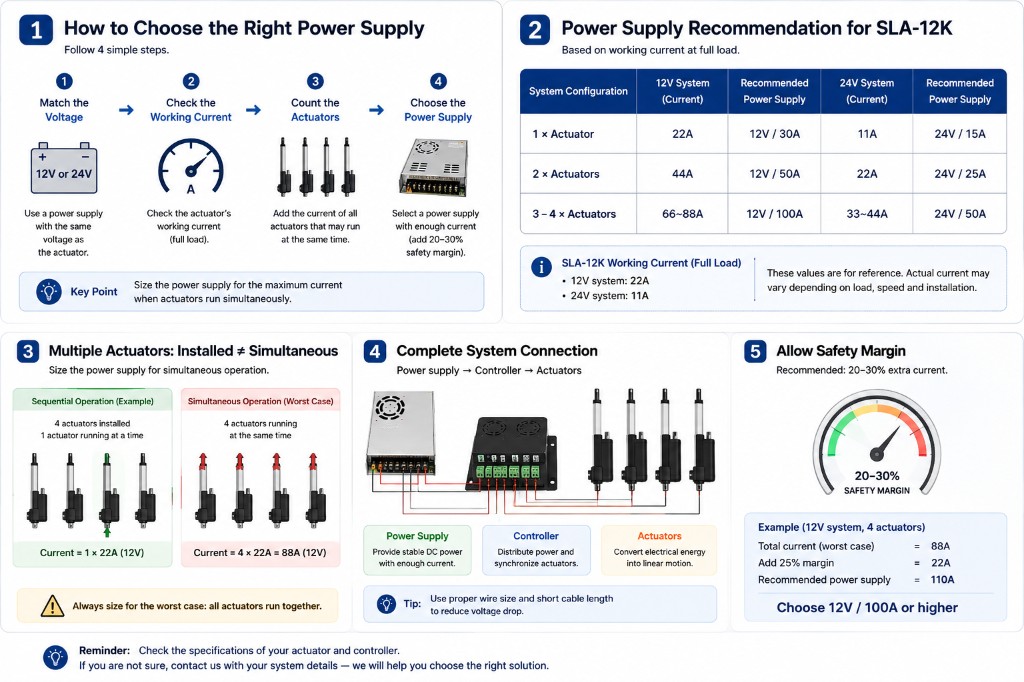
1. Match the Voltage
The first step is simple:
- 12V actuator → use a compatible 12V power system
- 24V actuator → use a compatible 24V power system
Do not choose a power supply based only on physical size or actuator force.
The actuator, power supply, and controller must use a compatible voltage.
For example, the SLA-12K is available in published 12V and 24V configurations.
2. Check the Actuator Current
Voltage tells you the electrical system voltage, but it does not tell you how much current the actuator needs.
For the SLA-12K, Elerover publishes:
| SLA-12K | 12V | 24V |
|---|---|---|
| No-load current | 3–4A | 1.5–2A |
| Full-load current | 15–22A | 8–12A |
This is why you should not select a power supply from no-load current alone.
An actuator that draws only a small current with no load can require substantially more current when moving a heavy load.
Use current data that represents the actual working condition.
3. How Many Actuators Run at the Same Time?
This is especially important for multi-actuator machines.
Imagine two machines.
Machine A
It has four actuators installed, but only one actuator operates at a time.
Machine B
It also has four actuators, but all four operate simultaneously.
Both machines have four actuators.
But they do not have the same power requirement.
That is why the important question is not:
“How many actuators are installed?”
It is:
“How many actuators can operate at the same time?”
For the SLA-12K, Elerover publishes a 24V / 50A recommended supply for a three-to-four-actuator 24V system.
What About the Controller?
If your system uses a controller, the controller also needs to handle the actuator voltage and current.
A typical multi-actuator system looks like this:
Power Supply → Controller → Linear Actuators
For synchronized applications, feedback and controller compatibility also matter.
For example, SLA-12K configurations can be supplied with Hall feedback for applications where position feedback or synchronized control is required.
If you need several actuators to move together, tell the supplier:
- number of actuators;
- voltage;
- load;
- whether they operate simultaneously;
- whether synchronization is required.
This makes it much easier to recommend the correct actuator, controller, and power supply combination.
12V or 24V: Which Should I Choose?
There is no universal answer.
Choose 12V when your machine already uses a 12V electrical system, such as some battery-powered equipment.
Choose 24V when your machine is designed around a 24V system or when the actuator/controller configuration makes 24V more suitable.
For SLA-12K specifically, the published full-load current is:
- 12V: 15–22A
- 24V: 8–12A
So the 24V version has lower published full-load current for this model.
However, do not assume that every 24V linear actuator has the same current requirement. Always check the exact actuator model.
Do All Linear Actuators Need the Same Power Supply?
No.
A small linear actuator and a heavy-duty actuator can have completely different electrical requirements.
For example, Elerover’s SLA-T50 has published rated-current examples around 2.0–3.5A, depending on voltage and configuration.
The SLA-12K can require much higher current.
This is why there is no universal answer such as:
“Every 24V linear actuator needs a 10A power supply.”
The correct answer depends on the exact actuator model and operating condition.
Common Mistakes
Choosing by voltage only
Knowing that an actuator is 24V is not enough. You also need its current requirement.
Using no-load current
The actuator in your machine will normally move a real load. Check current under the relevant working condition.
Ignoring simultaneous operation
Four actuators installed does not necessarily mean four actuators operate simultaneously.
Forgetting the controller
The power supply may be large enough while the controller is not.
Copying another actuator’s power supply
Different actuator models can have very different current requirements.
A Simple Selection Checklist
Before selecting your power supply, confirm:
| Question | Example |
|---|---|
| Actuator voltage? | 12V or 24V |
| Actuator model? | SLA-12K |
| Working load? | Application-specific |
| Current requirement? | Check model data |
| Number of actuators? | 1, 2, 3, 4… |
| How many run together? | 1 or multiple |
| Controller required? | Yes / No |
| Synchronization required? | Yes / No |
If you can answer these questions, power supply selection becomes much easier.
Need Help Choosing a Power Supply?
If you are not sure which power supply or controller your linear actuator system needs, you do not need to calculate everything before contacting us.
Send Elerover:
Actuator model + load + stroke + voltage + actuator quantity + how many operate simultaneously + control requirement
For example:
SLA-12K, 24V, four actuators, all four need to move together, synchronized control required.
With this information, we can review the application against the published actuator specifications and help you shortlist a suitable system for prototype evaluation.
Related Elerover Pages
- SLA-12K Linear Actuator
- SLA-T50 Linear Actuator
- Linear Actuator Controllers
- Linear Actuator Products
- Contact Elerover / Request a Quote
One actuator or four actuators? 12V or 24V?
Tell us what you need to move and how you want the actuators to operate. We can help you identify the key actuator, controller, and power-supply requirements before you order a prototype.
FAQ
What power supply do I need for a 12V linear actuator?
Use a compatible 12V supply with sufficient current capacity for the exact actuator and working load. Do not choose the amperage from voltage alone.
What power supply do I need for a 24V linear actuator?
Use a compatible 24V supply and check the actuator's working current. If several actuators operate simultaneously, the supply must support the combined requirement.
Can I use a 5A power supply for a linear actuator?
Possibly for some lower-current actuators, but not for every actuator. Check the published current of the exact model under the intended operating condition.
How do I power four linear actuators?
First determine whether all four need to operate simultaneously. Then select a compatible power supply and controller based on the exact actuator model, voltage, current, and control requirements.
Does a bigger power supply make the actuator stronger?
No. A larger power supply does not increase the actuator beyond its published mechanical capability.
المزيد من المقالات
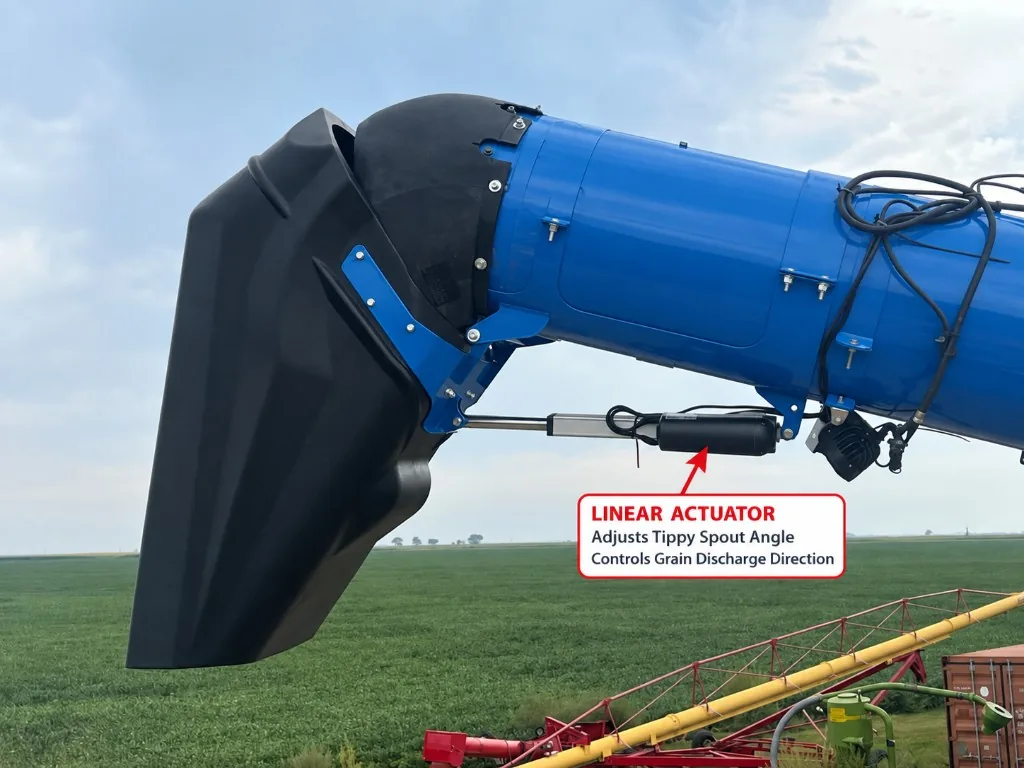
How an Electric Linear Actuator Adjusts an Unloading Auger Tippy Spout
Learn how an electric linear actuator can adjust an unloading auger tippy spout to improve grain discharge direction and trailer loading control.
قراءة المقال ←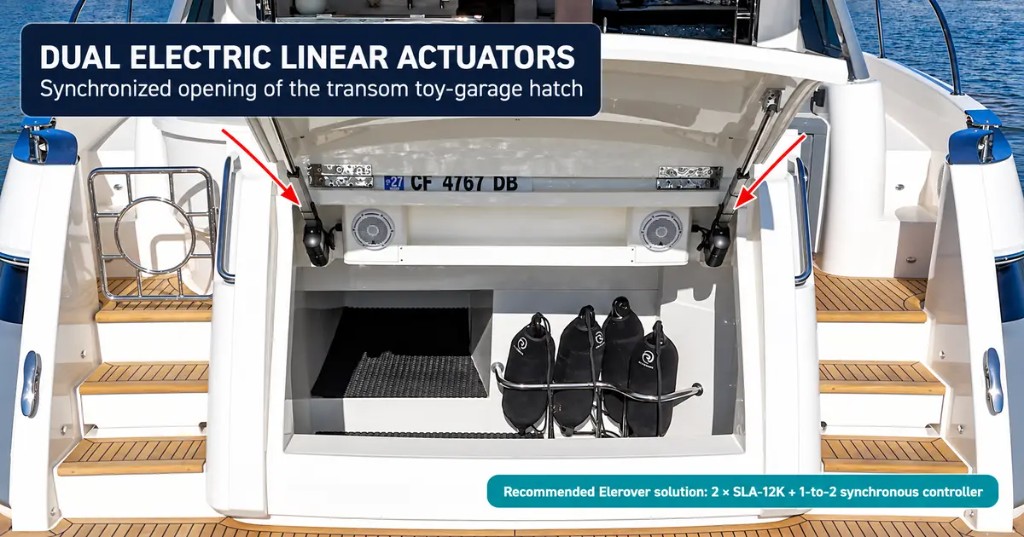
Dual Linear Actuators for Yacht Toy-Garage Hatches | SLA-12K
See how two synchronized electric linear actuators can open a yacht transom toy-garage hatch and how Elerover configures the SLA-12K system.
قراءة المقال ←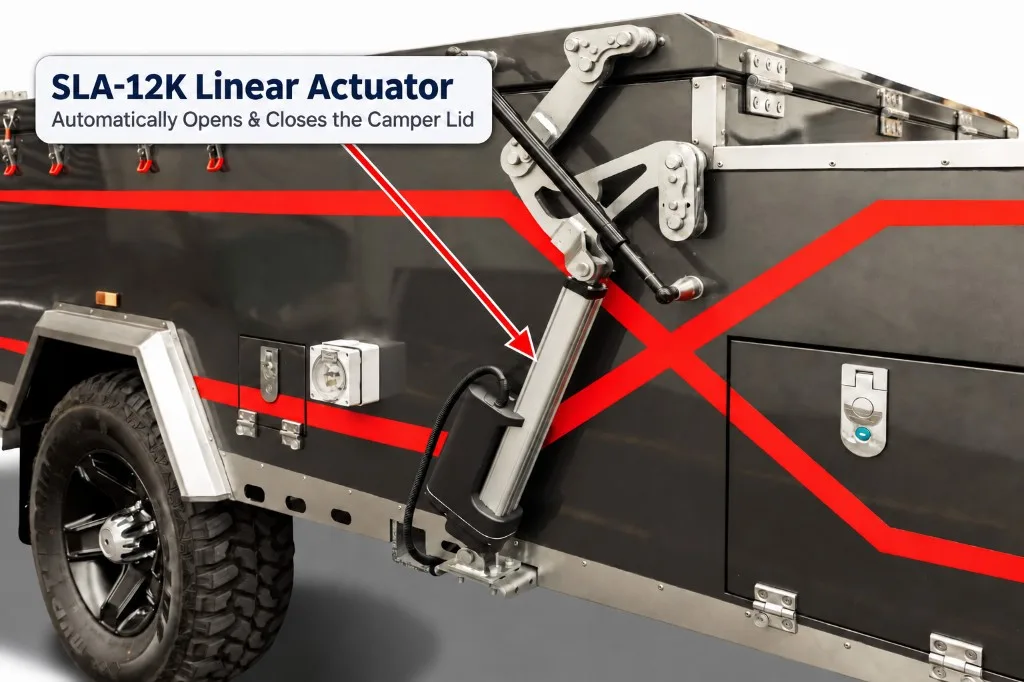
SLA-12K Linear Actuator for Automatic Camper Trailer Lids
See how a 12V or 24V SLA-12K heavy-duty linear actuator can automate the opening and closing of camper trailer lids and folding roof systems.
قراءة المقال ←