Dual Linear Actuators for Yacht Toy-Garage Hatches | SLA-12K
See how two synchronized electric linear actuators can open a yacht transom toy-garage hatch and how Elerover configures the SLA-12K system.
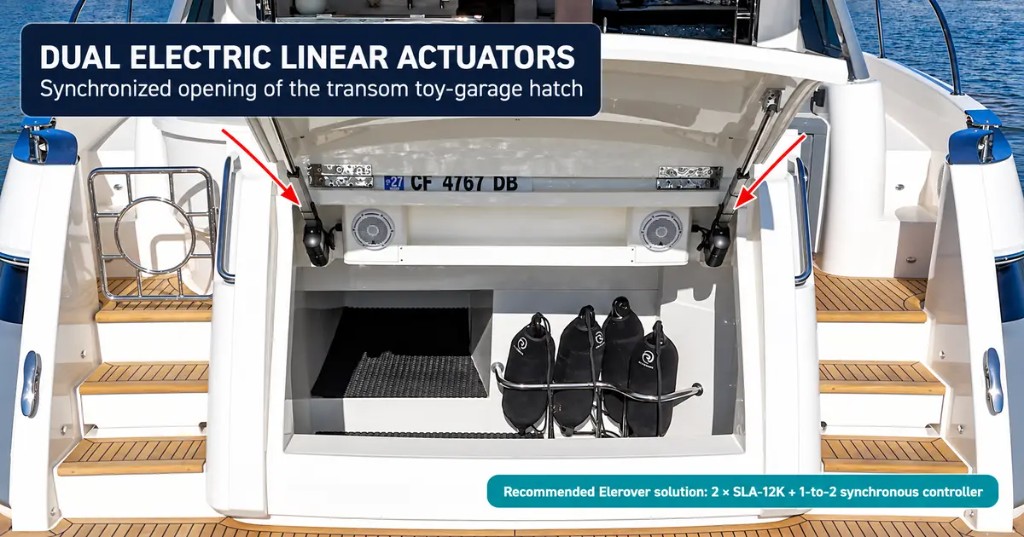
Large yacht storage hatches need controlled motion, balanced support and reliable closing. Electric linear actuators provide a compact way to open a transom toy-garage hatch and give users convenient access to paddleboards, diving equipment, fenders and other watersports gear.
The application photograph shows two electric linear actuators installed on opposite sides of the open transom hatch. This dual-actuator arrangement distributes the load across the wide moulded door and helps keep both sides moving together.
The Yacht Toy-Garage Application
A transom toy garage creates a large storage area behind the stern hatch. Because the door is wide and relatively heavy, two electric linear actuators can be installed on opposite sides to raise and lower it at the push of a button.
This function is separate from a hydraulic swim platform. The swim platform moves vertically, while the electric actuators rotate the storage hatch around its hinges.
What Do the Linear Actuators Do?
Each actuator is connected between the yacht structure and one side of the hatch. When both rods extend, they rotate the hatch upward around its upper hinges. When the rods retract, they guide the hatch back toward the closed position.
The actuators perform four important functions:
- Open the large transom hatch at the push of a button
- Support controlled movement through the opening and closing cycle
- Share the mechanical load across the left and right sides
- Hold the two sides of the wide hatch at a similar position during travel
The required actuator thrust cannot be calculated from hatch weight alone. Hinge position, actuator angle, mounting-point distance, centre of gravity, wind load and the force required near the closed position all affect the result.
Why Use Two Synchronized Actuators?
A wide composite hatch can twist or bind if one side moves faster than the other. Two ordinary actuators connected only to the same switch may gradually lose alignment because motor speed changes with load, voltage, temperature and mechanical friction.
A proper synchronized system uses position feedback from both actuators. The controller continuously compares their movement and corrects the output so that the left and right sides remain aligned.
For this type of yacht hatch, a suitable architecture is:
- Two matched electric linear actuators with Hall-sensor feedback
- One high-current one-control-two synchronous controller
- A correctly sized 12 V or 24 V DC power supply circuit
- Wiring and circuit protection sized for the combined starting current
- Pivoting brackets that prevent side loading on the actuator rods
Synchronization improves alignment, but correct hinge geometry and rigid mounting points are still required.
Recommended Elerover SLA-12K Solution
The Elerover SLA-12K heavy-duty linear actuator can be configured as an OEM solution for large electric hatches. For a dual-actuator system, select two matched SLA-12K units with compatible Hall feedback and connect them to a controller designed for the combined motor current.
| Parameter | SLA-12K series reference |
|---|---|
| Maximum thrust | Up to 12,000 N at the corresponding low-speed configuration |
| Working voltage | 12 V DC or 24 V DC |
| Stroke | Multiple standard and customized stroke options |
| Speed | Configuration-dependent; higher speed reduces available thrust |
| Protection | IP66 |
| Duty cycle | 10%, maximum 2 minutes of continuous operation |
| End-of-travel control | Built-in limit switches |
| Position feedback | Optional Hall-sensor configuration |
| Emergency operation | Manual-override option |
| Mounting | Front and rear clevis mounting |
For a heavy dual-actuator installation, the SLA-SCN2-HC synchronous controller is the more relevant Elerover controller reference. It is designed for two Hall-sensor actuators, supports 12–48 V DC systems and has a published maximum-current rating of 25 A. Final compatibility must be checked against the selected SLA-12K voltage, force/speed configuration and measured starting current.
Information Required for Actuator Selection
To configure the correct dual linear actuator system, send Elerover the following information:
| Required information | Why it matters |
|---|---|
| Hatch weight and dimensions | Establishes the basic load and centre of gravity |
| Hinge location | Defines the rotation axis |
| Closed and fully open mounting distances | Determines actuator stroke and installed length |
| Actuator mounting-point drawing | Allows force and angle evaluation throughout travel |
| Desired opening time | Determines the required actuator speed |
| 12 V or 24 V supply | Selects motors, controller and wiring |
| Maximum available current | Confirms controller, cable and fuse sizing |
| Cycles per hour | Confirms duty-cycle suitability |
| Available mounting space | Confirms body, clevis and manual-override clearance |
Photos are helpful, but a side-view drawing with hinge and mounting dimensions is the fastest way to evaluate the mechanism.
Benefits for Yacht and Marine Equipment OEMs
A properly engineered dual electric actuator system can offer:
- Push-button hatch operation without a separate hydraulic power unit
- Balanced movement across a wide transom door
- Flexible 12 V or 24 V integration
- Programmable or remote-control options
- Position feedback for synchronized motion
- Manual-override options for emergency access
- Custom stroke, cable, connector and mounting configurations
Frequently Asked Questions
Can two SLA-12K actuators run from one switch?
They can receive a common command, but a wide hatch should use matched feedback actuators and a compatible synchronous controller. A simple parallel connection does not actively correct position differences between the two sides.
Can one SLA-12K open the hatch?
That depends on the hatch structure and mounting geometry. One actuator may create uneven loading on a wide door. The photographed application uses two actuators, which is usually more suitable for balanced support across this type of hatch.
Which synchronous controller should be used?
The controller must match the actuator feedback signal, voltage and maximum starting current. For a heavy-duty pair, Elerover can evaluate the SLA-SCN2-HC or another compatible one-control-two controller after the SLA-12K configuration is selected.
Request an OEM Recommendation
Elerover supplies heavy-duty linear actuators and synchronized control systems for electric hatches, storage doors and other OEM motion projects.
Send us your hatch drawing, weight, hinge position, closed and open mounting distances, desired opening time, voltage, current limit and estimated annual quantity. We can review a configuration based on two SLA-12K Hall-feedback actuators plus a compatible one-control-two synchronous controller.
View the SLA-12K linear actuator or request an OEM quotation.
FAQ
Can two SLA-12K actuators run from one switch?
They can receive a common command, but a wide hatch should use matched feedback actuators and a compatible synchronous controller. A simple parallel connection does not actively correct position differences between the two sides.
Can one SLA-12K open the hatch?
That depends on the hatch structure and mounting geometry. One actuator may create uneven loading on a wide door. The photographed application uses two actuators, which is usually more suitable for balanced support across this type of hatch.
Which synchronous controller should be used?
The controller must match the actuator feedback signal, voltage and maximum starting current. For a heavy-duty pair, Elerover can evaluate the SLA-SCN2-HC or another compatible one-control-two controller after the SLA-12K configuration is selected.
المزيد من المقالات
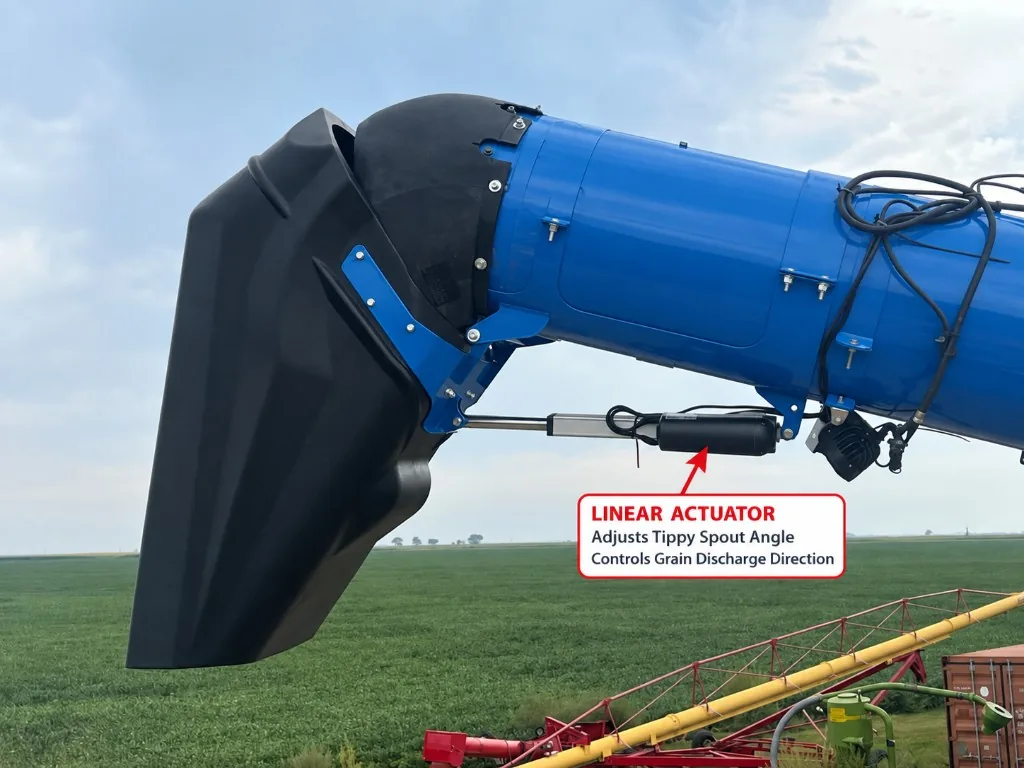
How an Electric Linear Actuator Adjusts an Unloading Auger Tippy Spout
Learn how an electric linear actuator can adjust an unloading auger tippy spout to improve grain discharge direction and trailer loading control.
قراءة المقال ←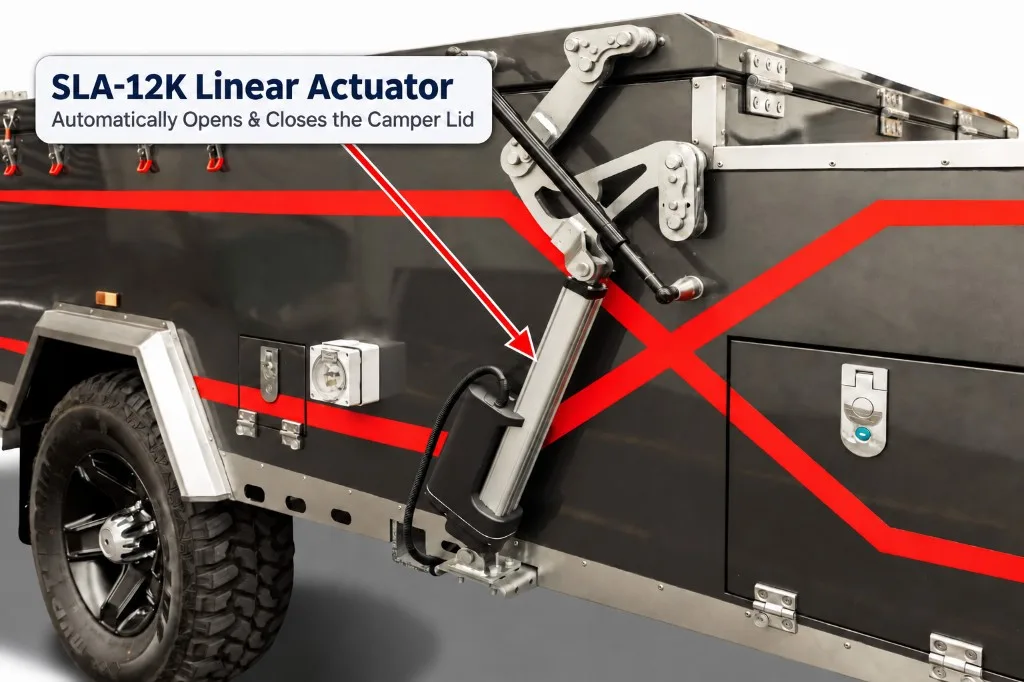
SLA-12K Linear Actuator for Automatic Camper Trailer Lids
See how a 12V or 24V SLA-12K heavy-duty linear actuator can automate the opening and closing of camper trailer lids and folding roof systems.
قراءة المقال ←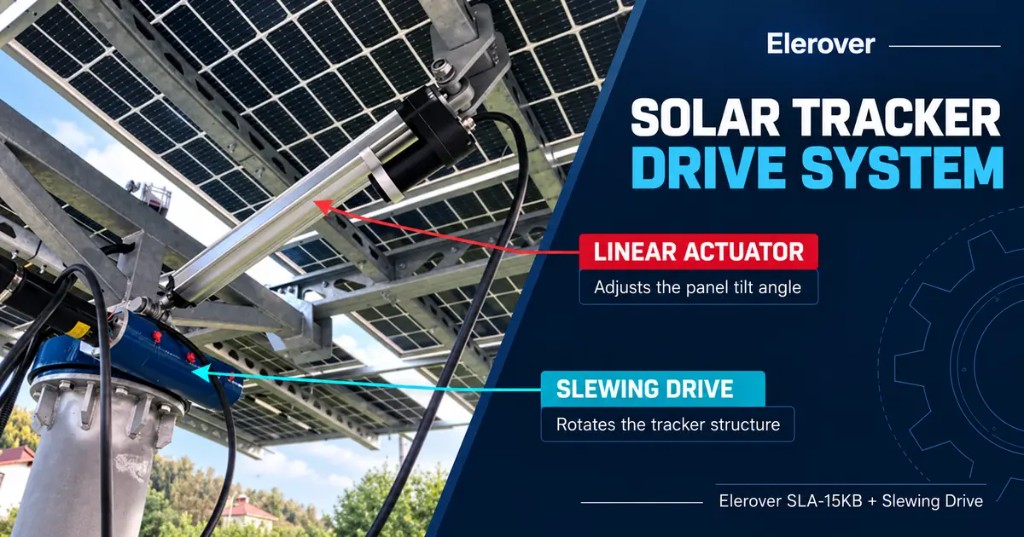
Linear Actuator and Slewing Drive for Solar Trackers
Learn how the Elerover SLA-15KB linear actuator and a slewing drive provide controlled tilt and rotation in single-axis and dual-axis solar tracking systems.
قراءة المقال ←