Hall Sensor vs Potentiometer Feedback in Linear Actuators: How OEM Engineers Should Choose
Compare Hall sensor and potentiometer feedback for electric linear actuators. Learn which option fits synchronization, position control, and OEM motion systems.
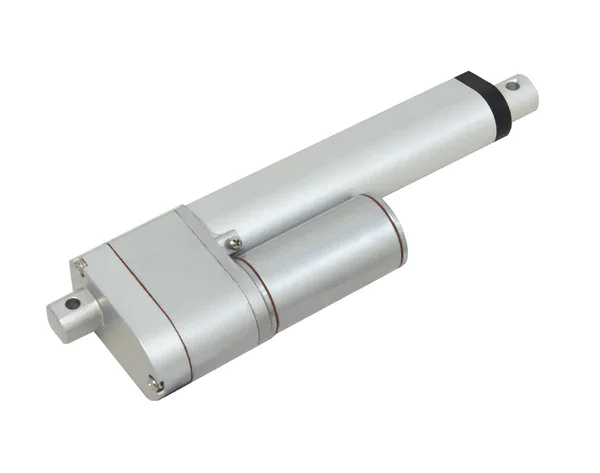
Choosing the correct linear actuator is not only about force, stroke, speed, and voltage. For many OEM projects, the feedback method is equally important.
Two common feedback options are Hall sensors and potentiometers. Both can provide information about actuator movement or position, but they work differently and are suited to different control strategies.
For engineers designing adjustable equipment, industrial machinery, smart furniture, medical equipment, agricultural systems, or other electromechanical products, understanding this difference early can simplify controller selection and reduce integration problems later.
This guide explains how Hall sensor and potentiometer feedback work, where each is useful, and what information you should provide when requesting a customized linear actuator.
Why Does a Linear Actuator Need Feedback?
A basic DC linear actuator can operate without external position feedback.
Apply DC power in one polarity and the actuator moves in one direction. Reverse the polarity and it moves in the opposite direction. Built-in limit switches can stop travel at the mechanical endpoints.
That is enough for many simple applications.
More advanced systems, however, may need to know:
- how far the actuator has moved
- whether multiple actuators are moving at the same rate
- the approximate or absolute actuator position
- when the controller should slow, stop, or reverse motion
- whether an actuator is lagging behind another actuator
This is where a feedback device becomes useful.
Elerover linear actuator configurations can include feedback options such as Hall sensors or potentiometers, depending on the actuator series and project requirements.
What Is Hall Sensor Feedback?
A Hall effect sensor detects changes in a magnetic field.
Inside a linear actuator, magnets and Hall sensors can be arranged so that the actuator generates electrical pulses while the motor or transmission rotates. The controller counts these pulses to estimate movement.
In simplified form:
motor rotates → Hall sensor produces pulses → controller counts pulses → movement is calculated
The number of pulses represents incremental movement rather than directly measuring an absolute mechanical position.
Main Advantages of Hall Sensor Feedback
Hall feedback is especially useful when a controller needs to continuously compare actuator movement.
Typical advantages include:
- digital pulse output
- no sliding electrical contact in the sensing element
- useful for measuring relative movement
- suitable for speed monitoring
- suitable for multi-actuator synchronization
- straightforward integration with compatible digital controllers
Why Hall Sensors Are Common in Synchronous Linear Actuator Systems
Imagine a machine uses four linear actuators to raise one platform.
Even if all four actuators are nominally the same model, real operating conditions can differ because of:
- uneven mechanical loads
- manufacturing tolerances
- friction differences
- changing supply voltage
- structural resistance
If all four motors simply receive power simultaneously, one side of the platform may move slightly faster than another.
A synchronous controller can use feedback signals to compare actuator movement and make corrections.
Hall pulse feedback is therefore commonly considered when an OEM project requires two, four, or more actuators to move together.
For example, Elerover’s SLA-12K heavy-duty actuator can be configured with Hall sensor feedback and paired with a suitable synchronous controller for multi-actuator systems.
What Is Potentiometer Feedback?
A potentiometer provides a variable resistance related to actuator position.
As the actuator extends or retracts, the potentiometer changes resistance. A controller can measure the resulting analog voltage and estimate the actuator’s current position.
In simplified form:
actuator moves → potentiometer resistance changes → analog voltage changes → controller estimates position
Unlike incremental Hall pulses, a potentiometer can provide a signal corresponding directly to the actuator’s position within its travel range.
Main Advantages of Potentiometer Feedback
Potentiometer feedback can be useful when a system needs:
- analog position information
- position presets
- intermediate stopping positions
- relatively simple position measurement
- integration with a PLC, microcontroller, or compatible control system
The exact electrical characteristics should always be confirmed for the selected actuator and controller before integration.
Hall Sensor vs Potentiometer: Key Differences
| Requirement | Hall Sensor | Potentiometer |
|---|---|---|
| Signal type | Digital pulses | Analog variable signal |
| Measures movement | Yes | Yes |
| Relative movement tracking | Very suitable | Possible with controller processing |
| Position indication | Calculated from pulse count | Signal corresponds to travel position |
| Speed monitoring | Well suited | Possible but less direct |
| Multi-actuator synchronization | Common choice | Depends on control architecture |
| Controller requirement | Pulse-counting input | Analog input |
| Typical OEM use | Synchronization and motion monitoring | Position control and presets |
Neither option is automatically better.
The correct choice depends on what the machine needs the actuator and controller to accomplish.
When Should You Choose a Hall Sensor Linear Actuator?
Consider Hall sensor feedback when your project requires synchronized movement or continuous motion monitoring.
1. Multiple Actuators Moving Together
This is one of the most important applications.
Examples include:
- lifting platforms
- large adjustable tables
- multi-point lifting mechanisms
- industrial fixtures
- synchronized access panels
- customized equipment using two or four actuators
The controller can compare Hall pulses from each actuator and compensate for differences in movement.
2. Speed Monitoring
Because Hall sensors generate repeated pulses during movement, a controller can calculate actuator speed from pulse frequency.
This can help detect whether an actuator is moving slower than expected.
3. Relative Travel Measurement
If the controller knows the relationship between pulses and mechanical travel, it can estimate how far the actuator has moved from a known reference position.
When Should You Choose a Potentiometer Linear Actuator?
A potentiometer may be more appropriate when the system primarily needs an analog representation of actuator position.
1. Adjustable Position Presets
Suppose an OEM machine needs several repeatable working positions rather than only fully extended and fully retracted positions.
The controller can monitor the potentiometer signal and stop at predefined values.
2. PLC or Microcontroller Position Input
Many control systems can read analog voltage signals.
A potentiometer-equipped actuator may therefore fit naturally into an existing control architecture, provided that the signal range and electrical interface are compatible.
3. Position Display
If a system needs to show an operator approximately where an actuator is within its stroke, analog position feedback can be useful.
Feedback Is Only One Part of Actuator Selection
A common sourcing mistake is to start with the sensor type before defining the mechanical requirements.
For an OEM project, first determine the basic actuator specifications:
Required Load
Define the actual push or pull force required and include an appropriate engineering safety margin.
Elerover’s actuator range covers compact motion products through heavy-duty electric actuators, with published electric linear actuator models reaching up to 17,000 N dynamic force.
Stroke Length
Stroke is the distance the actuator rod must travel.
Do not confuse stroke with total installation length.
Required Speed
Higher force and higher speed usually create different motor and gearbox requirements. Always specify the required speed under the expected working load, not only the desired no-load speed.
Voltage
Common DC architectures include 12 V and 24 V, while some Elerover actuator models offer additional voltage configurations.
Installation Space
Provide:
- available retracted length
- mounting-point distance
- mounting orientation
- bracket requirements
- space around the motor housing
This can prevent an actuator that meets the electrical specifications from failing mechanically during installation.
Environmental Protection
For outdoor or dusty applications, define the required IP protection level.
Elerover offers actuator models with model-specific protection ratings ranging from IP54 to IP69. The rating must be verified for the exact model rather than assumed across the complete product range.
Control Method
Finally, explain what the actuator needs to do.
For example:
- simple extend/retract
- remote control
- preset positions
- synchronized two-actuator movement
- synchronized four-actuator movement
- PLC control
- position monitoring
Once the control objective is clear, selecting Hall sensor, potentiometer, or another feedback configuration becomes much easier.
Example: Four-Actuator Lifting Platform
Consider an OEM designing a rectangular lifting platform supported by four electric linear actuators.
The initial requirements might be:
- four actuators
- 24 V DC system
- identical stroke
- simultaneous lifting
- uneven load possible across the platform
- platform must remain approximately level
Simply connecting four DC motors to the same power supply does not guarantee synchronized travel.
A better system architecture is:
- select actuators with compatible feedback
- connect each actuator to a multi-channel synchronous controller
- monitor movement from each actuator
- compare the feedback signals
- adjust individual motor operation when movement begins to differ
For this type of project, Hall sensor feedback is often a practical starting point because the controller can compare pulse counts between actuators. See also our SCN4-R four-actuator synchronous controller guide.
The final configuration still depends on load, stroke, speed, controller design, allowable synchronization error, and mechanical structure.
Questions to Send Your Linear Actuator Supplier
When requesting an OEM actuator with feedback, provide more than a general request such as “I need a Hall sensor actuator.”
A useful RFQ should include:
- application
- required push/pull force
- stroke length
- desired speed under load
- DC voltage
- quantity
- required feedback type
- number of actuators operating together
- required IP rating
- installation dimensions
- connector or wire requirements
- control method
- annual volume if known
If synchronization is required, also explain how many actuators must operate simultaneously.
This information allows the actuator and controller to be evaluated as a motion system, rather than as isolated components.
Choosing the Right Feedback System
The easiest way to choose between Hall sensor and potentiometer feedback is to start with the control objective.
Choose Hall sensor feedback when your system primarily needs pulse-based movement tracking, speed monitoring, or synchronization between multiple actuators.
Choose potentiometer feedback when your controller primarily needs an analog signal corresponding to actuator position.
For simple two-wire extend/retract operation, additional position feedback may not be necessary at all.
The actuator, feedback device, controller, mechanical structure, and power supply should ultimately be treated as one integrated motion system.
Need Help Selecting an Actuator and Feedback Configuration?
Elerover supplies electric linear actuators, synchronous controllers, lifting columns, slewing drives, and customized motion solutions for OEM/ODM projects.
When requesting a recommendation, send your load, stroke, speed, voltage, application, quantity, feedback requirement, and number of actuators that need to operate together.
This gives the engineering team enough information to identify a suitable published model or discuss an OEM configuration.
Browse the linear actuator category, controller category, SLA-12K product page, related smart furniture applications, or request a quote.
FAQ
Does every linear actuator need a Hall sensor?
No. Simple extend/retract applications can often use an actuator with built-in limit switches and no external position feedback. Hall feedback becomes more useful when the controller needs movement information, speed monitoring, or synchronization.
Can Hall sensors tell the absolute position of a linear actuator?
Hall sensors normally generate incremental pulses. A controller counts the pulses to calculate movement, so the system typically needs a known reference or homing strategy to establish position.
What does a potentiometer measure in a linear actuator?
A potentiometer changes electrical resistance as the actuator moves. A compatible controller measures the resulting analog signal and relates it to actuator position.
Which feedback type is better for synchronized actuators?
Hall sensor feedback is commonly used for synchronized multi-actuator systems because a controller can compare pulse counts from multiple actuators in real time. The final choice depends on the controller and actuator design.
Can four linear actuators run from one controller?
Yes, if the controller is designed for multi-actuator operation and the actuators provide compatible feedback and electrical characteristics. Elerover supplies synchronous controller solutions for single- and multi-actuator motion systems.
Does the SLA-12K support Hall sensor feedback?
Yes. Elerover publishes Hall sensor, potentiometer, and limit-switch signal options for the SLA-12K. A Hall-equipped configuration can be used with a compatible synchronous controller.
المزيد من المقالات
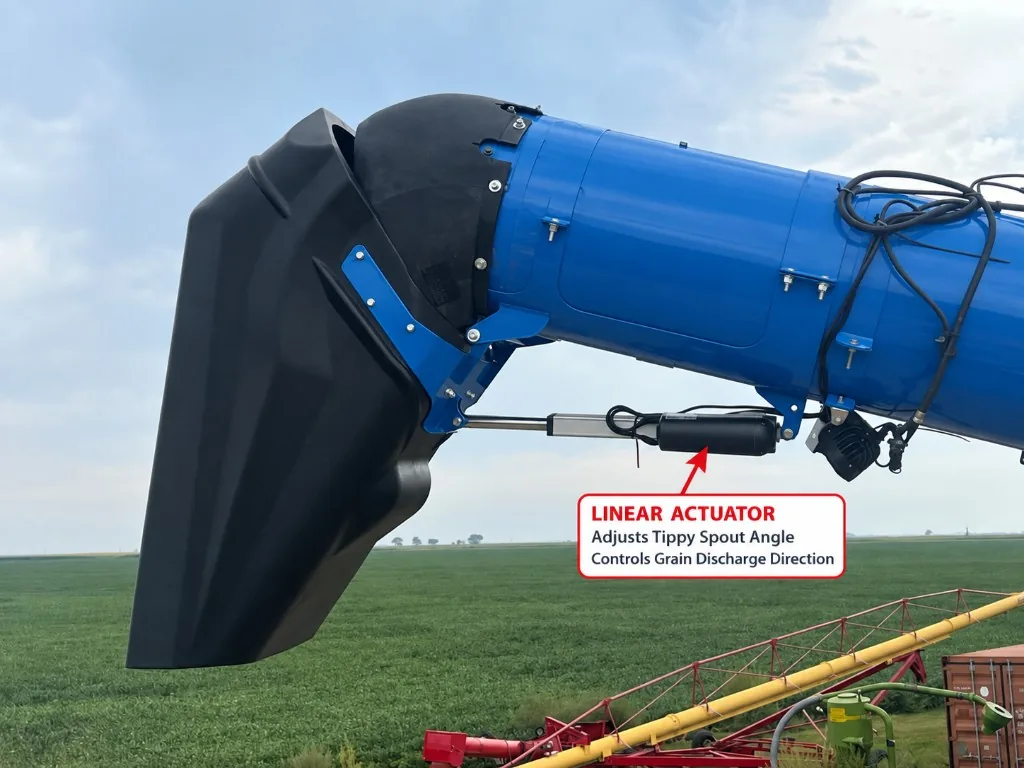
How an Electric Linear Actuator Adjusts an Unloading Auger Tippy Spout
Learn how an electric linear actuator can adjust an unloading auger tippy spout to improve grain discharge direction and trailer loading control.
قراءة المقال ←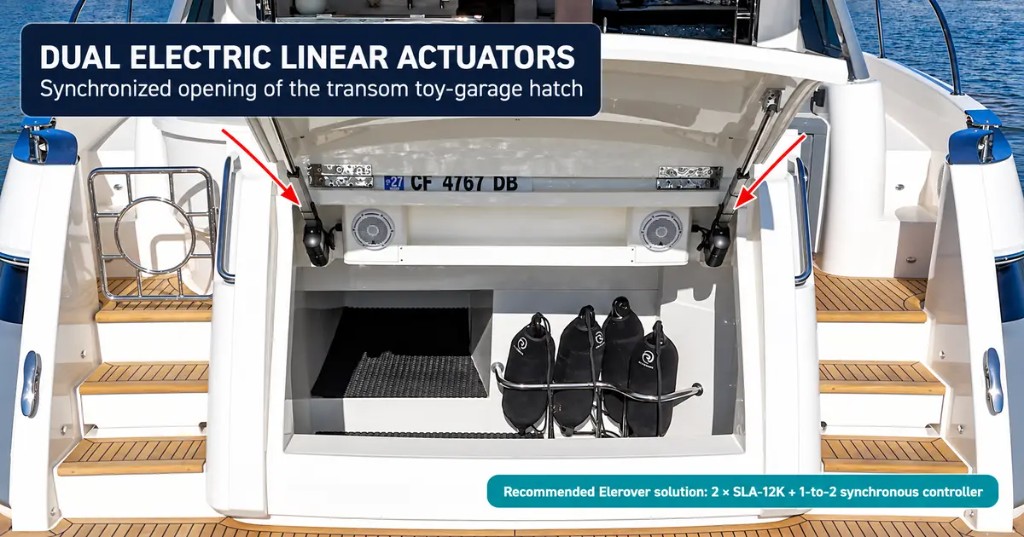
Dual Linear Actuators for Yacht Toy-Garage Hatches | SLA-12K
See how two synchronized electric linear actuators can open a yacht transom toy-garage hatch and how Elerover configures the SLA-12K system.
قراءة المقال ←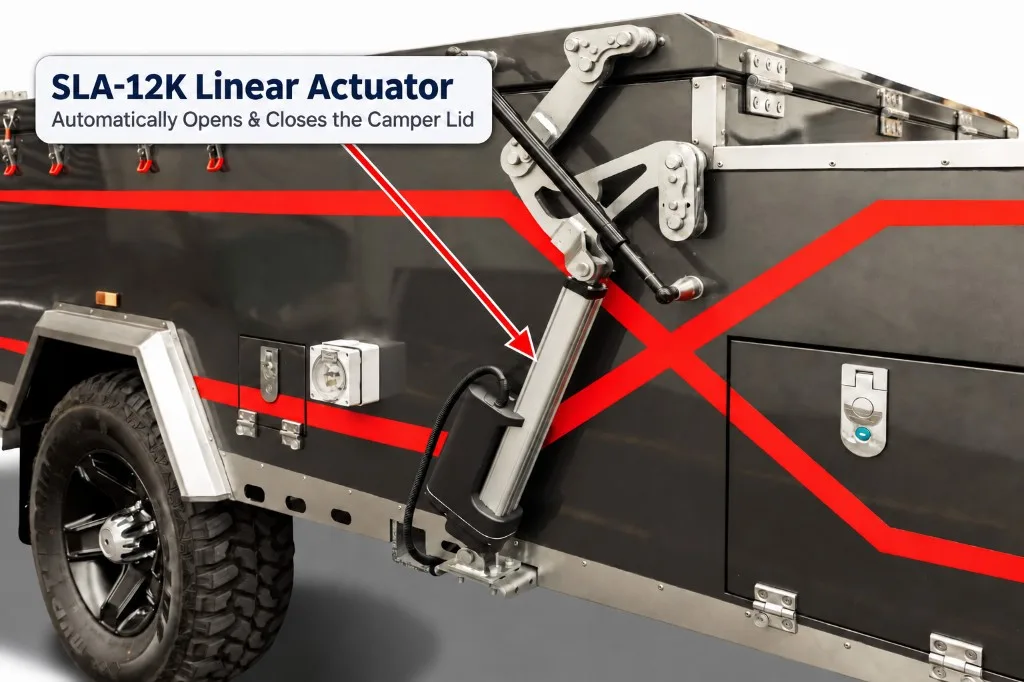
SLA-12K Linear Actuator for Automatic Camper Trailer Lids
See how a 12V or 24V SLA-12K heavy-duty linear actuator can automate the opening and closing of camper trailer lids and folding roof systems.
قراءة المقال ←